Production of iron ore pellets
Bentonite
Bentonite is traditionally used as a binder component of the batch for pellet production. The main purpose of bentonite is to ensure batch lumping during the production of green pellets and to bind the material particles during pellet drying before solid-phase sintering begins. Bentonite disperses well due to the hydration of exchangeable interlayer cations, turns into a matrix that binds the concentrate particles and maintains a uniform distribution of moisture throughout the pellet embryo as it grows to a finished granule. Bentonite is also used as an element for controlling the pelletizing process, since it allows, by changing its flow rate coefficient, to control the free moisture content in the batch fed to a drum or plate pelletizer and to use concentrates with a higher moisture content. When drying green pellets, bentonite is a source of channels for removing moisture, which allows increasing the drying rate of the granules.
Modern pelletizing technology for iron ore concentrates was developed in the 1950s using bentonite clay as an additive binder and it has remained the most widely used binder due to its efficiency and relatively low cost. Two types of bentonite are used to produce iron ore pellets: sodium bentonite and activated calcium bentonite. Sodium bentonite is more absorbent than calcium bentonite because the divalent calcium ions hold the clay platelets tighter than the monovalent sodium ions, allowing less water to pass between the platelets. Conventional unactivated lump calcium bentonite is now almost never used. Sodium bentonite has the highest swelling capacity. There are quite a few deposits of sodium bentonite, so the most common calcium bentonite is activated with soda ash - Na2CO3 in order to improve the physical properties of bentonite by partially replacing Ca ions with Na ions.
The primary activation with soda ash is carried out by the bentonite supplier. In this case, activation occurs due to the natural moisture content of the bentonite itself. Soda ash is added to the clay mined in the quarry with a moisture content of 24-28% after crushing to a class of 0-60mm in the amount of 2-3% of the bentonite mass. Bentonite mixed with soda ash is stored in open areas, where it is activated and dried to a moisture content of 18-21%. Some suppliers from South Asia dry bentonite to a moisture content of 12-16% in the open air without the use of special drying equipment. The final activation of bentonite (hyperactivation) is carried out, if necessary, by the consumer by directly adding an alkali solution - NaOH to the batch with its subsequent averaging in mixers and feeding for pelletizing. Hyperactivation of bentonite allows improving the quality of bentonite due to better distribution of bentonite in the structure of granules during pelletizing. Hyperactivation is carried out with a 46% alkali solution in a volume of 250ml to 500ml per ton of charge.
The use of hyperactivation allows reducing the consumption of bentonite. According to various experiments, the reduction in bentonite consumption can be from 10% to 25% while maintaining the quality indicators of raw and fired pellets.
The main criteria of bentonite quality, which are used by specialists at pelletizing plants, are the physical properties of the material: swelling index (and/or swelling) - ASTM 5890, montmorillonite content – XRD, water absorption (on a plate or according to Enslin) - ASTM E 946, methylene blue index - MERKBLATT VDG P-69/ASTM C837, moisture content, particle size distribution - CEN ISO/TS 17892, API Specification 13A/ISO 13500 and chemical properties - silicon oxide content - SiO2 (XRF), calcium oxide - CaO (XRF), sodium oxide - Na2O (XRF) and sulfur - S (ISO 22016). Each plant specifically determines the list of necessary definitions of bentonite quality characteristics, taking into account the availability of the necessary equipment, methods and standards, Independent laboratories are often brought in to control the quality of raw materials entering the enterprise.
To assess the suitability of bentonite, it is recommended to compare the quality ofground bentonite immediately before feeding it to the batch for pelletizing. This is primarilydue to the technological scheme of bentonite preparation (crushing, drying, grindingwith drying) and the type of equipment installed at each stage, which may change thequality indicators of raw bentonite. Based on the recommendations of bentonite manufacturersand experiments, it was found that bentonite prepared for feeding to the batchshould contain 86-94% of class 0.056mm and have a moisture content of 6-9%. A decreasein the content of class 0.056mm and a decrease in the moisture content of crushedbentonite can lead to a decrease in the quality characteristics of bentonite, which entailsan increase in its consumption in the batch and a negative impact on the processes offormation of raw pellets during pelletizing.The following are the world's major bentonite producers: Amcol (Minerals Technologies);Bentonite Performance Minerals LLC (US); Wyo-Ben Inc. (US); Black Hills Bentonite(US); Tolsa Group (Spain); Imerys (S&B) (France); Clariant (Switzerland); Bentonite Company LLC (Russia); Laviosa Minerals SpA (Italy); LKAB Minerals (Netherlands); Ashapura (India); Star Bentonite Group (India); Kunimine Industries (South America); Huawei Bentonite (China); Fenghong New Material (China); Changan Renheng (China); Liufangzi Bentonite (China); Bentonit Uniao (Brazil); Castiglioni Pesy Cia (Argentina); Canbensan (Turkey); Aydın Madencilik Bentonit (Turkey); KarBen (Turkey); G&W Mineral Resources (South Africa); Ningcheng Tianyu (China).
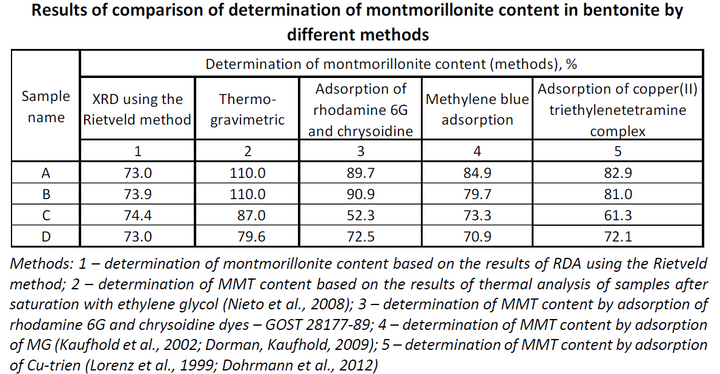
At the first stage, when selecting calcium activated bentonites at pelletizing plants, the content of silicon oxide, sulfur, sodium oxide, swelling index, montmorillonite content and water absorption are primarily assessed. Naturally, bentonites with the most optimal values for each of the indicators are selected. The content of silicon oxide and sulfur should be as low as possible, the ratio of sodium oxide to calcium oxide, swelling index, montmorillonite content and water absorption as high as possible. If with the definition of chemical composition, swelling index and water absorption of bentonite is more or less clear, there are certain developed world and state standards or methods, then the methods of determining the content of montmorillonite are very diverse and often differ between the supplier and the consumer and at many industrial enterprises are a stumbling block in the correctness of determining the value of this indicator. Some methods of determining the content of montmorillonite (MMT) are associated with the calculation of determining the adsorption value of organic dyes (by adsorption of rhodamine 6G and chrysoidine). Despite the fact that these methods are outdated, have a large error and determine the sorption capacity of montmorillonite and not its content, they continue to be used at some industrial enterprises producing pellets. The following generally accepted methods include the assessment of montmorillonite determination by the value of cation exchange capacity (by adsorption of methylene blue or by the value of adsorption of triethylenetetramine copper (II) complex). These methods are used in the laboratories of world suppliers of bentonite, as they have a relative accuracy of determination of this indicator. There is also a method of thermogravimetric analysis, but it has not found its distribution due to the use of specialized equipment for its implementation. The presence of such minerals as zeolite, amorphous silica, crystal balite, calcite and other clay minerals (vermiculite, kaolinite, halloysite, etc.) in bentonite rock significantly affects the adsorption indices of organic dyes and as a consequence, the results of measuring the montmorillonite content. The sorption properties of a particular montmorillonite, the magnitude and distribution of the layer charge, the composition of the absorbed complex, the parameters of micro and mesoporosity, and other textural and structural features of montmorillonite associated with the geological conditions of formation play a major role in determining the correct montmorillonite content using various methods. Impurities and inclusions of impurities of other minerals with high sorption capacity and amorphous phases also have a major impact on this indicator. Leading bentonite producers and suppliers and some customers have been switching to determining montmorillonite content using X-ray diffraction using the Rietveld method (XRD) in the last decade, which is the most correct methodological approach for determining the quantitative content of crystalline mineral phases in a mixture (rock, soil, material) and is the reference method for calculation, with the results of which all other methods for determining montmorillonite content are compared.
At the second stage of testing, the effect of bentonite on the properties of green pellets is assessed. Initially, batches with different bentonite consumption are prepared in laboratory conditions, then green pellets are rolled in a laboratory plate or drum pelletizer. The quality of green pellets is assessed according to the following criteria: crushing strength, drop strength, and particle size distribution. Some of the pellets are placed in baskets and installed on a firing machine in a layer of green pellets for firing or firing is carried out in a specialized laboratory that has a pellet firing unit. After firing, the pellets are cooled from the baskets. Then the quality is assessed according to the following characteristics: compressive strength and impact strength, abrasion and chemical composition. Based on the assessment of three components - the quality characteristics of the bentonite itself, green and fired pellets - the suitability of bentonite for pelletizing on an industrial scale is determined. At the final stage of assessing the quality of bentonite, industrial tests are carried out lasting at least 30 days, where the entire technological cycle is studied, starting from the preparation of bentonite to its introduction into the batch and ending with the effect on the quality characteristics of raw and fired pellets directly under industrial conditions. The dosage of bentonite should be as low as possible because pellets containing more bentonite in the batch require higher production costs and contain a higher silica content. This gives the industry an incentive to use bentonite in such a way as to ensure sufficient strength at lower consumption. Since bentonite has a high silicon oxide content, its increased consumption leads to a decrease in the iron content in the batch and as a consequence, in the pellets. Each kilogram of bentonite added to the batch reduces the iron content in the pellets by 0.05-0.07%. However, there are two criteria that have a negative effect on reducing bentonite consumption - the moisture content in the concentrate and the hardness of the process water itself, which is used in the production of the concentrate and is used to moisten the batch in the pelletizers. The humidity of the iron ore concentrate fed to pelletizing should be slightly lower than the optimal moisture capacity of the concentrate and as a consequence, the moisture capacity of the batch itself. This is especially important for the production of unfluxed pellets - a batch consisting of concentrate and bentonite, with the possible addition of limestone in the amount of 3-7kg/ton of concentrate to increase the basicity of the pellets to the level of 0.08-0.15units and a polymer binder in the amount of 50-200grams/ton of concentrate. The humidity of the concentrate and the humidity of such a batch have almost the same values taking into account the consumption of concentrate and bentonite in the batch and their humidity. In the production of fluxed pellets with a basicity modulus from 0.15 to 0.6units or highly fluxed pellets from 0.6 to 1.2units.
The moisture content of the concentrate and the moisture content of the batch may differ significantly due to the addition of ground ordinary or dolomitized limestone with a moisture content of 0.3-0.6%. The higher the consumption of the fluxing additive and the basicity modulus of the pellets, the lower the moisture content of the batch compared to the moisture content of the concentrate added to the batch. Due to the high moisture capacity of bentonite, it is used to regulate the pelletizing process by changing the flow rate into the batch. With a wet batch, its flow rate is increased, with a dry batch, its flow rate is reduced. To form an optimal granular composition of pellets, the batch fed to the pelletizer must have such a moisture capacity that it is possible to add water to the pellet embryo formation zone. In practice, pelletizers often operate without using water, since the moisture capacity of the batch is close to optimal and the production of raw pellets is carried out by changing the bentonite flow rate, loads and rotation speed of the plate or drum. As already mentioned above, the next criterion influencing the properties and consumption of bentonite is the composition of the water used for enrichment of the concentrate
and the composition of the water added during the pelletizing process of the raw pellets.
The presence of dry residue in process water, increased content of calcium, magnesium and chloride salts have a great influence on the reactivity of bentonite. Numerous studies conducted with various types of water (distilled, ordinary soft water, and water with increased hardness or mineralization) have shown that increased water hardness has a negative effect, since it deactivates bentonite due to the replacement of sodium ions with calcium ions. Active bentonite comes into contact with free calcium (from slaked lime or calcium in process water), the activation process is reversed and bentonite returns to calcium bentonite. The results of the studies have clearly shown that higher concentrations of calcium reduce or destroy the binding properties of bentonite.
Naturally, an increase in the consumption of bentonite in the batch leads to a decrease in the iron content in the pellets.
The reduction in the quality characteristics of bentonite due to deactivation leads to the need to increase its consumption in the batch by 20-30% to maintain the strength characteristics of raw and fired pellets. Pelletizing plants often include not only quarries, but also mines or separately operating mines of other enterprises. Therefore, one of the main reasons for increased water mineralization is the discharge of highly mineralized mine waters into the tailings pond of the recycled water used for enrichment and pelletizing. The presence of a large amount of chlorine-containing and sulfate salts in the process water used for enrichment and pelletizing leads to an increase in their content in the charge, raw pellets and the gas phase after pellet firing. The presence of chloride and sulfur compounds in the resulting deposits and gas phase causes corrosion of metal structures, dust and gas cleaning devices, especially precipitation, corona electrodes and electrostatic precipitator housings, leads to partial overgrowing of the grate of the firing trolleys and chemical wear of the grates. Therefore, when designing and selecting gas cleaning units, it is necessary to take into account this requirement for the concentration of chlorine and sulfur in exhaust gases. To date, there is no practically working scheme for reducing water mineralization by adding activator reagents due to their high cost and the need to process a large amount of recycled water for enrichment and pelletizing processes.
+